
YOU HAVE IDEAS. NOW DECIDE WHAT DESERVES TO BE BUILT.
WHAT SHOULD YOU BUILD?
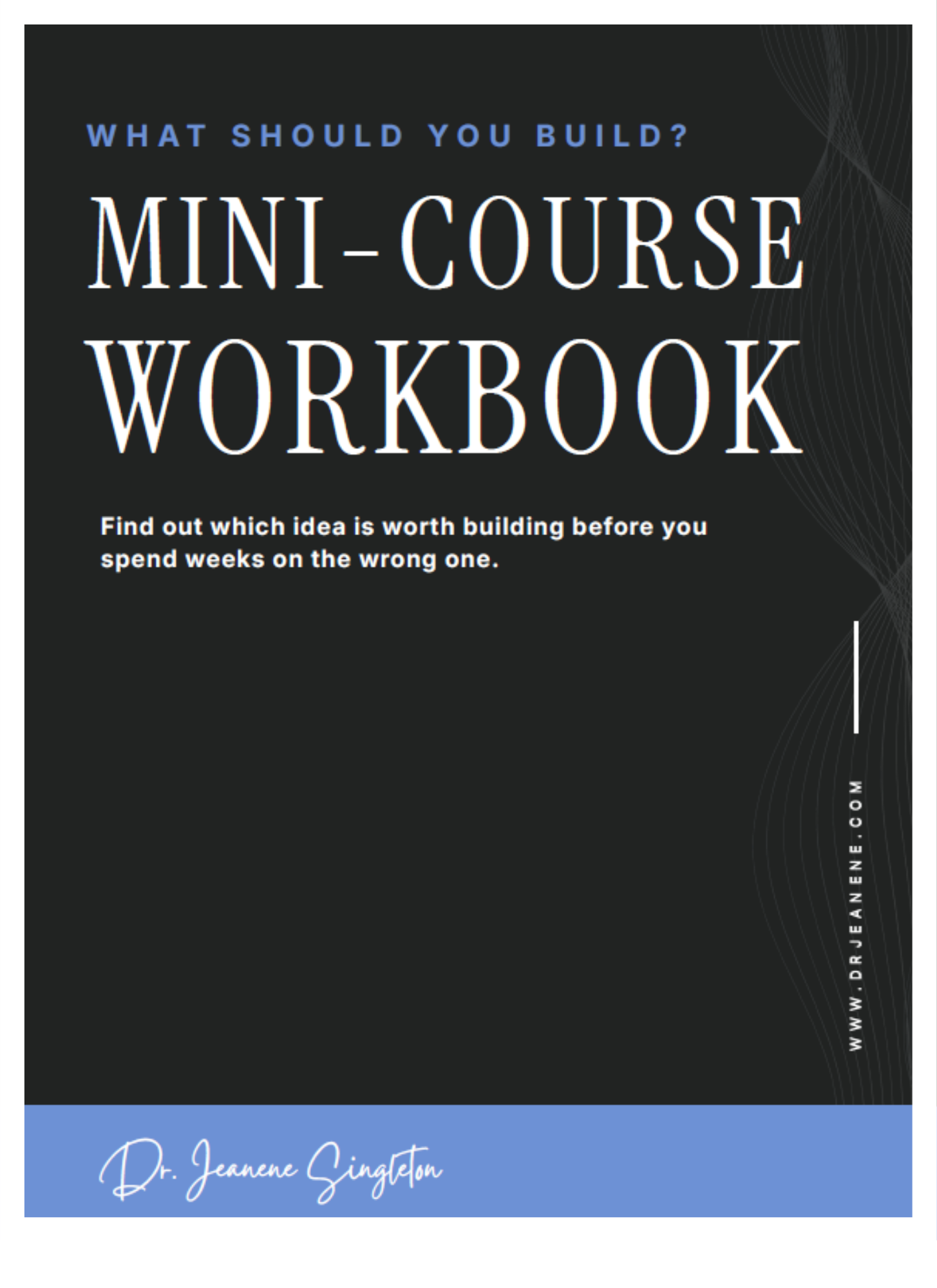
Find out which idea is worth building before you spend weeks on the wrong one.
You don’t need more brainstorming. You need evidence.
Bring one idea or a few. In about 1½–2 hours, you’ll figure out who it’s for, whether people are already trying to solve the problem, what it should become, and what Version 1 actually needs.
You’ll leave with a clear call: PROCEED. REFINE. Or PAUSE.
Having an idea isn’t the same as having something worth building.
Once you have an idea, building can feel like the obvious next step. You start outlining it, designing it, choosing a platform, making graphics, recording something… and pretty quickly, you’re deep into production.
But all that work tells you something about your ability to create. It doesn’t tell you whether this particular idea deserves your time.
That’s the decision I want you to make first. Before you spend the next few weeks building, you need enough evidence to decide whether to move forward, change the idea, or leave it alone for now.
I learned this one myself. I once spent seven months building an AI app. It sounded impressive, and I knew how to make it, so I kept going before answering the questions that should have come first.
“My ability to build it was never proof that I should.”
Not everything should be a course.
One of the easiest ways to overbuild is to choose the format before you know what the person needs. Sometimes the answer is a course. Sometimes it’s something much smaller.
Tool / Template
Something they can grab and use.
Guide / Workbook
Help working through a problem.
Short Training
One specific skill or task.
Course
Connected steps, practice, and progression.
Workshop / Guided Experience
Your feedback or working through it together.

I’ve spent more than 25 years turning expertise into learning that works.
I’m Dr. Jeanene Singleton, a learning scientist with a Doctor of Education in Leadership and Innovation. I’ve built thousands of courses and learning experiences and partnered with hundreds of subject-matter experts to turn what they know into something other people can understand, apply, and use.
A big part of that work has been deciding what someone needs to be able to do, what belongs, what doesn’t, and what deserves to be built in the first place.
That’s why this process doesn’t assume your idea should move forward. Sometimes the most useful thing I can help you see is that it shouldn’t, at least not yet.
Four decisions before you build.
You don’t need proof that an idea will sell. You need enough evidence to make a better call than “this sounds good, so I’m going to build it.”
Discover
Start with what’s already there.
Look at the expertise, experience, and problems you already know something about. If you’re bringing several ideas, this is where you choose the one worth testing first.
Define
Get specific about the person and the result.
Clarify who the idea is for, what they’re trying to solve or accomplish, and where you want them to finish.
Demand
Look outside your own head.
Look for evidence that people are already trying to solve the problem — searching, asking, and paying for help. You’re not looking for perfect proof. You’re looking for enough real-world evidence to stop relying on a hunch.
Decide
Make the call before you start producing.
Bring the evidence together and decide whether the idea should PROCEED, REFINE, or PAUSE. If it moves forward, you’ll choose the format that fits and define what Version 1 needs to include. If it’s PAUSE, the process still worked. That’s evidence saving you from spending the next month building the wrong thing.
No idea yet? Start with the free What Could You Sell? finder →
What you walk away with
A decision you can build from.
By the end, you won’t just have more notes about your idea. You’ll know whether it should PROCEED, REFINE, or PAUSE — and what that decision means for what you do next.



Before you decide
A few things you might be wondering.
You don’t need to arrive with everything figured out. Here are the questions I’d want answered before I bought it too.
What if I don’t have any ideas yet?
Start with What Could You Sell? It’s my free 10-minute finder that helps you turn what you already know into three possible digital product ideas.
Then come back here when you have something you want to test. Find 3 ideas first →
What if I only have one idea?
That’s completely fine. You don’t need several ideas to use this process.
Bring the one you have and put it through Discover → Define → Demand → Decide before you commit to building it.
How long does it take?
Plan for about 1½–2 hours. It’s self-paced, so you can work through it in one sitting or break it up.
What if my idea gets a REFINE or PAUSE?
REFINE means there’s something there, but one piece needs adjusting before the idea moves forward. Your workbook shows you which one.
PAUSE means the evidence isn’t strong enough yet, so you can decide whether to revisit the idea later or test something else.
Finding that out before you spend weeks building is useful information.
Do I need to use AI?
No. The four AI prompts are optional.
They’re there to help you research demand, examine buyer language, look at the paid market, and review your thinking. You verify what you find and make the final decision.
What if my idea needs to be a course?
When your decision is PROCEED and the right format is a course, The 5-Day Build takes you from that decision to a focused, launch-ready course.
Your $47 counts toward it, and the link in your Finish lesson applies the discount for you.
You don’t need to decide that now. First, figure out what deserves to be built. See what’s in The 5-Day Build →
What if I already bought The 5-Day Build?
You don’t need to buy this separately. Day 1 of The 5-Day Build takes you through these decisions as part of the full course-building process.
What is the refund policy?
Because What Should You Build? is a digital product with immediate access to the course and downloadable materials, purchases are final.
You can review the full terms here .
READY WHEN YOU ARE
Make the decision before you make the product.
Give the idea 2 hours before you give it the next month.
Bring the idea you’ve been thinking about. You’ll leave knowing whether to move forward, what needs to change, or whether it makes sense to pause for now.
If your idea earns PROCEED, you’ll pull that decision into a one-page Product Decision Brief you can build from. If the answer is REFINE or PAUSE, you’ll still know why — and what to do next.
WHAT SHOULD YOU BUILD?
Pick your best idea and plan Version 1.
A focused mini-course with a fillable workbook to help you figure out what’s worth building before you spend weeks building the wrong thing.
one-time payment
If the right format is a course, your $47 counts toward The 5-Day Build.